Where Are You Starting With BPO?
Your starting point determines which BPO decisions deserve the most attention. Launching a new engagement creates different risks from expanding an established program or replacing a current provider. Identify where you’re starting before evaluating solutions so you can focus on the right priorities, questions, and selection criteria.
Launching a New BPO Engagement
You may be outsourcing a function for the first time or introducing BPO support for a new service, market, program, or customer group. The decisions you make now will establish how the engagement operates.
Define what is in and out of scope, assign ownership, prepare the knowledge and resources the provider will need, and establish governance from the beginning. Document your current volume, costs, service levels, quality, and other relevant measures so you have a clear baseline for evaluating results.
Expanding or Restructuring an Existing Program
You may be adding capacity, capabilities, channels, locations, or another provider to an established operation. Start by identifying the constraint you need to address and where the expanded model should create value.
Then determine how the new resources will connect with your current operation. Pay close attention to handoffs, shared systems, reporting, leadership, and performance expectations across teams and providers. The expanded model should increase flexibility and performance without creating confusion or inconsistency.
Improving or Replacing a Current Provider
A disappointing BPO engagement can have more than one cause. The provider may be falling short of expectations. The original scope may no longer fit the work. Your business may have outgrown the delivery model, governance structure, technology, or level of partnership you originally selected.
Diagnose the source of the gap before designing the replacement.
Determine:
- What must improve?
- What must continue without interruption?
- Which knowledge, systems, and responsibilities must transfer?
- Where the existing model needs to change?
- Which internal decisions or resources contributed to the problem?
This helps you solve the underlying issue instead of carrying it into the next engagement.
★ Quick Action: Identify your starting situation
Write one sentence explaining what has created the need to act now. Then identify the two or three decisions that require the most attention based on whether you are launching, expanding, restructuring, improving, or replacing.
Seven Decisions Shape the Value of Your BPO Engagement
The function you outsource is only one part of the strategy. You are also defining how the work will operate, who will own each responsibility, how performance will be measured, and what must happen for the engagement to succeed.
A weakness in one decision can limit the entire model. A strong partner can help you refine the answers, but your business needs a clear starting point.
1. The outcome:
What business, customer, or operational result must improve?
2. The scope:
Which work, customers, channels, responsibilities, and service levels belong in the engagement?
3. The delivery model:
Where should the work happen, and how should the team be structured?
4. The operating approach:
How will people, processes, knowledge, technology, and governance support performance?
5. The transition:
What must be prepared, transferred, tested, or protected before launch?
6. The partner:
Which provider has the expertise, operating discipline, judgment, and transparency the work requires?
7. The plan:
How will you turn these decisions into an actionable strategy with clear internal ownership?
★ Quick Action: Write your outcome statement
We need to improve [current condition] from [baseline] to [target] by [date] so that [business impact].
If you don’t have a reliable baseline yet, identify the information you need to establish one.
What Business Process Outsourcing Services Can You Use?
Business process outsourcing services can support customer-facing operations, extend your internal capacity, and manage the work behind the customer experience. You can outsource a complete business function, a defined workflow, or a specific source of operational pressure. The right starting point is where outside support creates the most value for your customers and your internal team.
Strengthen Customer-Facing Operations
Customer service is one of the most familiar uses of BPO. You can use an external team to manage customer questions, orders, account support, scheduling, sales inquiries, or another part of the customer journey.
The model can be as focused or comprehensive as the work requires. It might provide after-hours coverage for one channel, an omnichannel team operating across voice and digital interactions, or complete management of the customer care function with shared performance goals.
When customers need specialized help, outsourced technical support can connect them with trained agents who understand your products, systems, and escalation paths. The provider should build that expertise into its hiring, training, knowledge management, and quality programs.
Add Capacity Where Your Team Needs It Most
Rapid growth, seasonal demand, a product launch, or a persistent hiring gap can create more work than your internal team can absorb. Flexible customer support staffing gives you a way to expand capacity while protecting service levels and keeping your core team focused.
Capacity support can take several forms. You might add a dedicated team, use overflow coverage during peak periods, or build a flexible staffing model that adjusts with demand. Before choosing the structure, define the expected volumes, schedules, required skills, and performance standards.
Improve the Work Behind the Customer Experience
Many business process outsourcing services support work customers never see. Data entry, billing support, claims processing, order management, document review, dispatch, and other back-office workflows all affect how quickly and accurately you serve them.
Look for work with a clear process and a measurable result. Then decide whether you want the provider to execute the current workflow or help improve it. A strong BPO partner should be able to show where better routing, documentation, automation, or ownership could reduce delays, errors, and manual effort.
What Is Business Process Outsourcing?
Business process outsourcing, or BPO, is an arrangement in which an external provider supports or manages a defined business function, process, or workflow.
The provider’s role depends on the engagement. You may need trained people to extend your internal capacity. You may want a partner to manage day-to-day delivery, including staffing, training, quality, reporting, and workforce planning. You may also need help improving the operation through stronger processes, technology, automation, and performance management.
Each approach is a form of BPO. The difference is how much of the work and operational responsibility the provider owns. Your scope and desired level of partner ownership determine how the engagement works.
How Does Business Process Outsourcing Work?
You begin by defining the result you need and the work connected to it. A potential BPO partner should then evaluate your operating requirements and recommend Business process outsourcing begins with defining the result you need and the work connected to it. A potential BPO partner should then evaluate your operating requirements and recommend an approach designed around that result.
A strong partner will ask enough questions to understand how the work moves through your operation. Your demand patterns, service expectations, systems, security requirements, internal resources, and operational risks should all influence the proposed solution.
Those requirements shape the team, delivery location, technology, transition plan, and governance structure around the realities of the work.
After launch, the provider performs the defined work and measures performance against the expectations you established together. Depending on the partnership, the provider may also identify process gaps, recommend improvements, introduce new technology, and help the operation adapt as your needs change.
As those needs change, return to the desired result to determine how the operating model should evolve.
How Is BPO Different From Call Center and Contact Center Outsourcing?
Call center and contact center outsourcing are specific forms of BPO. Call center outsourcing primarily covers voice interactions. Contact center outsourcing extends support across channels such as voice, email, chat, messaging, and social media.
Business process outsourcing can include those customer-facing services and the processes surrounding them. An engagement may center on outsourced call center solutions, customer care, or technical support. It may also include data processing, billing support, dispatch, documentation, and other back-office workflows.
The label alone doesn’t define the engagement. One company may need overflow support during peak hours while keeping operational control in-house. Another may want a provider to manage an entire function, improve its workflows, and share responsibility for performance. Both are BPO models, but they require different capabilities and levels of ownership.
Before you compare providers, clarify three things:
The result: What condition needs to improve, and what outcome should the engagement produce?
The work: Which interactions, transactions, workflow stages, channels, and customer groups belong in scope?
The ownership: Which responsibilities will you retain, which will move to the provider, and which will require shared accountability?
These decisions give you a clear foundation for evaluating services, delivery models, technology, costs, and potential partners against the needs of your operation.
What Results Can BPO Help You Improve?
BPO can increase capacity, improve service performance, add specialized capabilities, and make your operation more flexible. The value of the engagement depends on the problem you need to solve and the results you choose to pursue.
Lower labor costs may support the business case. Evaluate them alongside speed, quality, scalability, customer experience, and the time returned to your internal team. Build your measures of success around the operational pressure you need to relieve.
Create Capacity for Growth
BPO can help you absorb higher volumes without requiring your internal team to rebuild the entire operating infrastructure. You gain access to recruiting, training, workforce management, technology, and leadership resources already designed to support service delivery.
This can shorten the time required to add support while giving your employees more room to focus on the work where their knowledge, relationships, and decision-making create the greatest value.
Improve Service Performance
When long waits, growing backlogs, or inconsistent quality affect customers, a BPO partner can bring more structure to the work. Clear routing, better staffing alignment, stronger knowledge resources, and daily performance visibility can improve response times, resolution, and consistency.
Choose measures tied to the experience you need to improve. Response time, first-contact resolution, quality, customer satisfaction, backlog, abandonment, and customer effort each reveal a different part of performance.
Gain Capabilities You Don’t Want to Build Alone
The right partner can give you access to specialized talent, new delivery locations, advanced analytics, automation, and customer experience technology. You can introduce those capabilities without developing and maintaining every resource internally.
McKinsey’s work on global business services and sourcing reflects this broader opportunity. Modern sourcing strategies can support service transformation, digital capabilities, analytics, and long-term operational improvement alongside efficiency.
Build More Flexibility Into the Operation
Your needs will change. Volume may rise or fall. Customers may adopt new channels. A new product, acquisition, regulation, or market may change the skills and coverage you need.
Build flexibility into the engagement from the beginning. Define how you’ll adjust staffing, add capabilities, move work between locations, or introduce new technology as conditions change. A well-designed BPO model should give you a clear path for adapting without destabilizing service.
Which BPO Delivery Model Fits the Work?
The right BPO delivery model matches the work’s requirements for talent, coverage, collaboration, compliance, continuity, customer experience, and cost. Onshore, nearshore, offshore, and blended models can all perform well when the location and operating structure fit those requirements.
Evaluate the specific labor market, site, leadership team, and business continuity plan behind any model. The location category gives you a starting point. The operating details determine how well the model will perform.
Onshore BPO
An onshore model keeps service delivery within the United States. It can be a strong fit when you need close cultural and geographic alignment, U.S.-based delivery, regulatory familiarity, or frequent collaboration with internal teams.
Domestic delivery typically carries higher labor costs, so validate the value it creates for the work. Consider the available talent, required specialization, scalability, coverage, leadership structure, and total cost.
Nearshore BPO
Nearshore delivery places the work in a nearby country, often with significant time-zone overlap. It can provide access to bilingual or multilingual talent while supporting real-time collaboration with your U.S. team.
Evaluate the specific country and delivery site. Language depth, labor availability, infrastructure, security, business continuity, and leadership capabilities can vary substantially between locations.
Offshore BPO
Offshore delivery can provide access to large talent pools, extended coverage, specialized capabilities, and meaningful cost efficiency. It often works well when the operation has documented processes, clear service expectations, and strong governance.
Pay close attention to communication practices, knowledge transfer, leadership, quality management, security, and continuity. Labor savings lose value when the model creates rework, inconsistent service, or additional management demands for your internal team.
Blended Delivery
A blended model places different parts of the work where they fit best. You might keep sensitive or highly collaborative work onshore while using nearshore or offshore teams for extended coverage, specialized support, or repeatable workflows.
This approach can balance proximity, talent, scale, continuity, and cost. It also creates more handoffs, so define ownership, escalation paths, reporting, and performance expectations across locations.
Shared, Dedicated, and Hybrid Teams
Location is only one part of the model. You also need to decide how the team will be structured.
Shared teams support more than one client and can work well for lower or variable volumes.
Dedicated teams focus on your program and offer deeper brand, product, and process alignment.
Hybrid teams combine a stable core team with flexible capacity for spikes, after-hours support, or specialized work.
Choose the structure based on volume, complexity, knowledge requirements, security, and the level of integration you need.
★ Quick Action: Segment the work before choosing the model
Divide the work into two or three segments. For each segment, record:
- Required skills and experience
- Coverage and language needs
- Level of customer or data sensitivity
- Need for real-time internal collaboration
- Volume and demand variability
- Process complexity and maturity
Then evaluate the strongest delivery location and team structure for each segment. You may find that different parts of the engagement need different models.
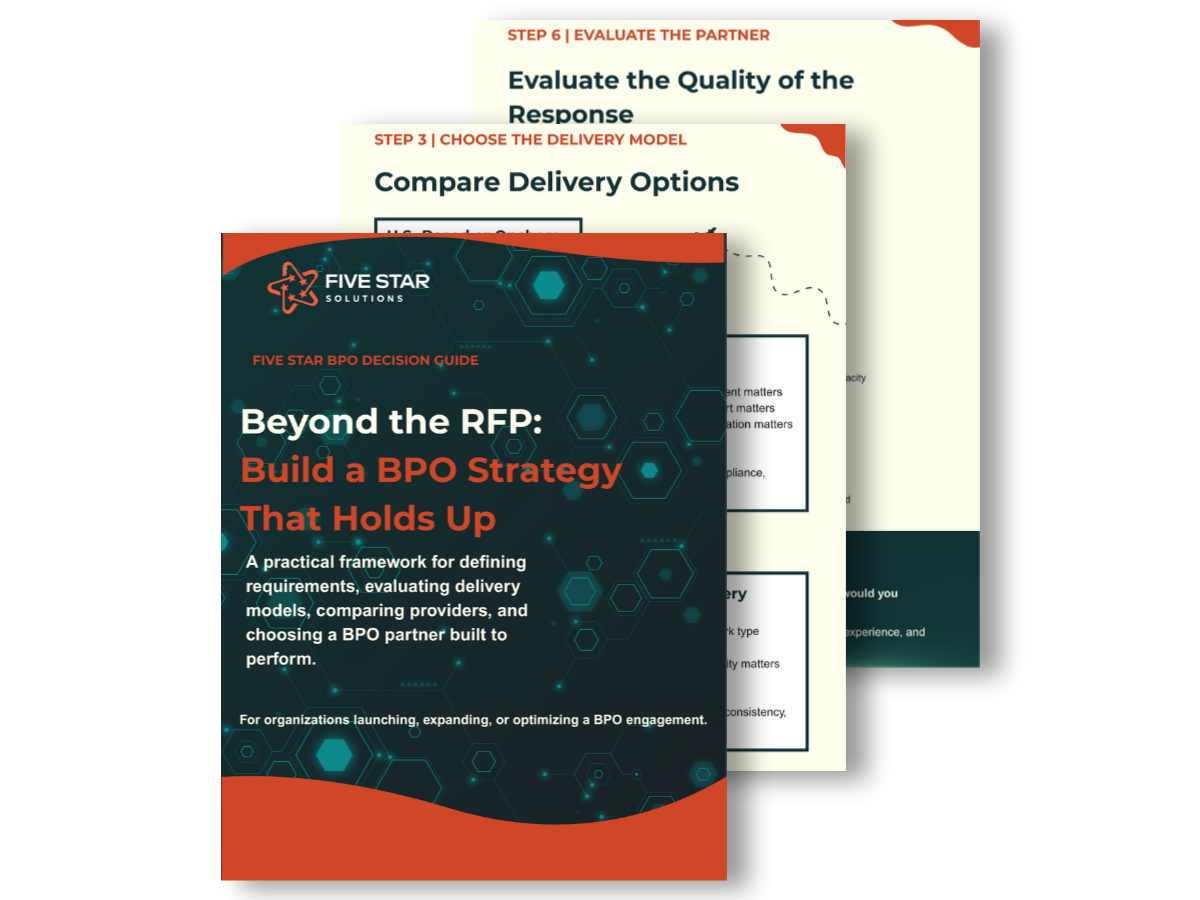
Download the Five Star BPO Decision Guide to clarify your requirements and plan a smoother transition.
What Should You Outsource?
Strong candidates for outsourcing have measurable outcomes, transferable knowledge, and clearly defined ownership. Look for work where a BPO partner can relieve capacity pressure, add specialized capabilities, improve performance, or manage a workflow more effectively.
Complex work can also be outsourced when the provider has access to the right knowledge, systems, authority, and escalation paths.
You may already know the broad function you want to outsource. The next step is deciding exactly which work belongs inside the engagement. “Customer service” only names the function. A usable scope defines the customer groups, interaction types, channels, hours, escalation levels, systems, and responsibilities the provider will support.
Follow the Work From Beginning to End
Map how a request, transaction, or case moves through your operation today. Identify where the work enters, who touches it, which systems agents use, how exceptions are handled, and where delays or confusion occur.
Use this map to determine whether the provider should own a single task, a complete workflow, or the broader operation. It will also expose the dependencies and handoffs you need to address during implementation.
Decide What You Want to Keep
Retain the work where your internal team’s authority, expertise, or relationships matter most. You may keep policy decisions, sensitive escalations, strategic accounts, or highly specialized technical issues while the provider manages the surrounding workflow.
Define the handoffs as carefully as the outsourced work. Your customers experience the complete process, including every transfer between teams.
Choose the Right Level of Partner Ownership
Decide what you want the provider to contribute beyond staffing. Your engagement may call for additional capacity, day-to-day management, shared accountability for performance, or leadership in process and technology improvement.
That distinction can materially change your results. In one technical support engagement, the operation faced 4,000 unresolved tickets and response times of up to nine days. Five Star aligned workforce capacity, redesigned routing and escalation, strengthened knowledge resources, and established daily governance.
Within two months, the backlog was cleared, response time fell to 4.5 hours, and the abandon rate dropped below 1 percent. See how a redesigned technical support operation restored performance.
The results came from improving how the work operated alongside workforce capacity.
★ Quick Action: Create an ownership map
Create three columns:
Place each workflow, decision, escalation, system responsibility, performance measure, and improvement activity in one column.
Flag anything that doesn’t have a clear owner. Those gaps can create confusion during transition and ongoing delivery.
How Much Does BPO Cost?
BPO cost depends on the operating model, delivery location, scope, staffing, technology, and service requirements. Two engagements with the same number of agents can have very different costs because the work, coverage, leadership, and risk are different.
A credible estimate requires defined volumes, responsibilities, performance expectations, and operating requirements. Without that information, an hourly rate or per-agent estimate offers limited insight into the total cost.
How Is BPO Pricing Structured?
Providers may price services by full-time employee, productive hour, transaction, customer contact, fixed monthly fee, or agreed outcome. Many engagements use a hybrid structure that combines a predictable base cost with variable charges or performance incentives.
The pricing model determines how volume, productivity, and performance risk are shared. Evaluate whether the structure fits the predictability of the work and the level of ownership you expect from the provider.
Understand the Main Cost Drivers
When you request pricing, give each provider enough information to account for:
- Delivery location: Labor markets and operating costs vary across onshore, nearshore, and offshore locations.
- Work complexity: Specialized, regulated, technical, or judgment-heavy work requires different recruiting, training, and management.
- Staffing structure: Dedicated, shared, full-time, part-time, and flexible teams carry different cost models.
- Coverage: Extended hours, weekends, holidays, and 24/7 operations affect staffing and leadership requirements.
- Technology: Licensing, integrations, automation, reporting, security, and support may be included or priced separately.
- Leadership and governance: Management ratios, reporting, quality oversight, workforce planning, and continuous improvement require resources.
- Compliance and controls: Regulated work may require additional training, access controls, audits, documentation, and oversight.
- Transition requirements: Knowledge transfer, implementation, testing, and parallel operations may create one-time costs.
Compare the Complete Operating Model
Ask each provider to explain what the price includes, which assumptions it depends on, and what could cause it to change. The lowest rate can produce a higher total cost once you account for management fees, technology, training, overtime, implementation, rework, or additional demands on your internal team.
Compare productivity and outcomes alongside price. Faster resolution, stronger quality, lower turnover, better forecasting, and effective automation can all change the economics of the engagement.
Use the requirements you defined earlier to normalize the proposals. A fair comparison requires providers to price the same scope, service levels, coverage, technology, and responsibilities. When those assumptions differ, the totals alone won’t tell you which solution offers the best value.
★ Quick Action: Build one pricing assumptions sheet
Give every provider the same:
- Volumes and demand patterns
- Required hours and coverage
- Channels and languages
- Work types and complexity
- Staffing and leadership requirements
- Technology and integration needs
- Service expectations
- Security and compliance requirements
- Transition assumptions
When a provider recommends changing an assumption, document the reason and its effect on price, performance, and risk.
This gives you a more credible comparison than placing proposal totals side by side.
How Is AI Changing BPO?
AI is expanding what a BPO partner can improve. You can use it to make agents more effective, simplify repeatable work, improve decisions, and give customers easier ways to complete routine tasks.
The result still comes first. Choose technology based on the experience, process, or performance measure you want to improve.
Match the Technology to the Work
Build your approach across four categories:
- Human-led work: Keep people at the center of complex, sensitive, high-value, or judgment-driven interactions.
- Agent assist: Give agents real-time guidance, knowledge, summaries, and next-best actions so they can work faster and more consistently.
- Workflow automation: Automate repeatable steps such as routing, documentation, validation, status updates, and follow-up.
- Self-service and virtual agents: Let customers complete simple tasks or get reliable answers without waiting for a live agent.
A strong digital CX and AI strategy connects these capabilities. The customer should be able to move between self-service and human support without losing context or starting over.
Build AI Around a Measurable Use Case
AI adoption alone doesn’t create value. McKinsey found uneven results among early adopters of generative AI in customer care, reinforcing the need to connect each use case to clear operational goals and implementation plans.
Start with a defined source of effort or friction. You might improve first-contact resolution with better knowledge access, reduce handle time with automated summaries, or move a specific high-volume inquiry into self-service.
Establish the baseline, target, controls, and customer impact before you scale the solution.
Gartner’s guidance for customer service leaders also emphasizes combining AI tools with the strengths of human agents. As routine work changes, agents need the training and knowledge to handle more complex interactions with confidence.
Use Automation to Improve the Whole Operation
The strongest results often come from combining technology with process and workforce improvements. A health benefits provider used automation, intelligent routing, expanded CRM access, agent assist, and AI-supported training to reshape a high-volume member support program.
Within six months, the program reduced costs by 30 percent, automated 20 percent of call volume, increased first-call resolution by 10 percent, and accelerated onboarding by 40 percent. See how the health benefits provider combined AI, automation, and operational changes.
Use the same discipline in your engagement. Decide where people create the most value, where technology can remove effort, and how you will protect quality, compliance, and customer trust.
★ Quick Action: Define one AI or automation candidate
Choose one high-volume interaction or workflow creating repeatable effort.
Record:
- What happens today
- Current volume and performance
- The effort or friction you want to reduce
- The result you want technology to improve
- How you will measure the change
- Where human judgment must remain
- Which customer, quality, security, or compliance controls are required
Use this information to evaluate a specific use case instead of a broad AI promise.
How Do You Choose a BPO Partner?
Choose a BPO partner by evaluating its relevant experience, operating discipline, quality of recommendation, improvement capabilities, and commercial transparency. Compare every provider against the same requirements and evidence.
The proposal shows you what a provider wants to sell. The evaluation process shows you how the provider thinks and operates.
Give potential partners enough context to make a meaningful recommendation. Then look closely at the questions they ask, the assumptions they challenge, and the connections they make between your problem and their proposed model.
Look for Relevant Experience and Judgment
Ask for examples involving similar work, customer needs, complexity, and operating challenges. Look beyond the final results. Ask about the starting conditions, changes the provider made, time required, obstacles encountered, and role the client played.
Relevant experience should sharpen the recommendation. A provider with sound judgment can explain which capabilities and lessons transfer to your situation and where your engagement requires a different approach.
Examine How the Provider Will Run the Work
Dig beneath the staffing plan. Ask how the provider will recruit, assess, train, coach, schedule, and retain the people supporting your program. Review its approach to quality, knowledge management, forecasting, reporting, security, business continuity, and continuous improvement.
Make ownership explicit. You should know who will make decisions, address issues, approve changes, and lead each part of implementation and ongoing operations.
Review its approach to:
- Quality
- Knowledge management
- Forecasting and workforce planning
- Reporting and analytics
- Security and compliance
- Business continuity
- Governance
- Continuous improvement
Make ownership explicit. You should know who will make decisions, address issues, approve changes, and lead each part of implementation.
Test the Quality of the Recommendation
Ask each provider:
Based on what you have learned about our operation, what would you recommend we improve or approach differently?
A strong response should connect the recommendation to evidence from your operation. It should explain the tradeoffs, dependencies, risks, and expected value.
Generic promises and broad technology claims won’t give you enough information to make a confident decision.
★ Quick Action: Use the recommendation test
Ask the question before you give the provider your preferred answer.
Evaluate whether the response:
- Reflects a real understanding of your operation
- Challenges an assumption constructively
- Connects the recommendation to your desired result
- Explains risks and tradeoffs
- Identifies internal requirements or dependencies
- Shows how the provider would create value beyond the initial request
The quality of the answer can tell you more than another capabilities presentation.
Choose a Partner That Can Evolve With You
Your first scope is unlikely to be your final scope. Look for a partner with the operating discipline to perform today’s work and the curiosity to keep improving it.
One Five Star partnership with a global office products manufacturer has evolved for more than 15 years. Process refinement, workforce alignment, expanded self-service, analytics, and AI-enabled workflows helped increase service levels by 49% and response speed by 76%. See how the CX model evolved through sustained optimization.
Long-term value grows when both teams can identify new opportunities, make informed changes, and remain accountable for performance.
Compare Providers Using the Same Evidence
Create a scorecard based on the priorities you defined before the search. Weight the capabilities essential to your engagement and score every provider against the same criteria.
Your comparison should include:
- Relevant experience and measurable results
- Solution fit and quality of recommendation
- Talent and workforce approach
- Operating model and improvement capability
- Technology, security, and integration
- Governance and transparency
- Implementation and transition readiness
- Commercial fit and pricing clarity
The Five Star BPO Decision Guide includes a weighted partner comparison scorecard you can use to organize this evaluation.
Is BPO Right for Your Business?
BPO may be right for your business when an outside partner can improve an important result, provide capabilities you need, and create more room for your internal team to focus. The strongest opportunities involve work that can be clearly scoped, measured, and managed through defined responsibilities.
You may be ready to build or revisit your BPO strategy if:
- Growth or changing demand is straining your current capacity.
- You need specialized talent, technology, coverage, or operational expertise.
- Service performance has stalled or declined.
- Hiring, training, or managing the work is consuming too much internal time.
- Your current provider or delivery model no longer fits the business.
- You need more flexibility, resilience, or support for a new program or market.
The process doesn’t need to be fully optimized before you outsource it. A BPO partner may be able to help identify gaps and improve the operating model.
You still need an internal owner, access to the right knowledge and systems, and enough clarity to explain the desired result, work, requirements, and risks. BPO may be premature when the business cannot support those conditions or expects a provider to resolve decisions that still need to be made internally.
You don’t need every answer before speaking with potential partners. A strong provider can help you validate assumptions, identify missing requirements, and shape the solution from there.
Avoid a Costly BPO Decision
Unclear requirements lead to mismatched proposals, costly rework, and preventable delays. The Five Star BPO Decision Guide helps you define the right strategy before you choose a partner.
- Define outcomes and scope
- Compare delivery models
- Reduce transition risk
- Evaluate partners
- Build your BPO Strategy Brief
Download the Five Star BPO Decision Guide and move forward with greater clarity and confidence.
START BUILDING!